One Unified Model
One submission must handle car, drone, quadruped, and handheld trajectories at once.
IROS 2026 Competition · Cross-Platform Inertial Positioning
Estimate 3D body-frame velocity from raw 6-axis IMU with one unified model across car, drone, quadruped, and handheld motion.
This applies to every team, including those who have already submitted to Kaggle. The Kaggle leaderboard is provisional: official final standings are decided only after the organizers re-execute the top teams' submitted models. To be eligible for the final ranking you must, in addition to submitting predictions:
main.tex and ieeeconf.cls. On Overleaf: New Project → Upload Project → select the zip. Maximum 6 pages excluding references, 7 in total; the appendix does not count. The report is due 23:59 US Eastern Time, 23 September 2026 — three days after the leaderboard closes — and is submitted by attaching it at the end of the challenge Form. All numbers in Tables III–V must come from the official scoring service, not a local re-implementation.Teams missing any of the three, or whose model cannot be re-executed, are removed from the final ranking regardless of leaderboard position. Full details on the Rules and Evaluation tabs.
Challenge design
Training and validation data include platform labels. The anonymized test set does not, requiring a single model to generalize across radically different dynamics without switching between platform-specific experts.
One submission must handle car, drone, quadruped, and handheld trajectories at once.
Test labels and platform-revealing trajectory identifiers remain hidden from participants.
Predicted velocities are integrated, aligned with SE(3) Umeyama, and scored equally across platforms.
Reference checkpoints, training code, and a browser demo provide a reproducible starting point.
Benchmark coverage
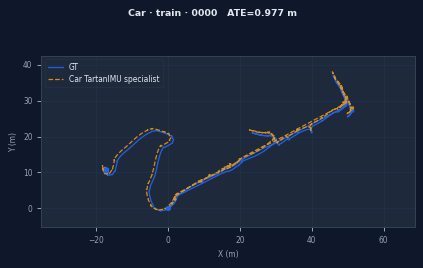
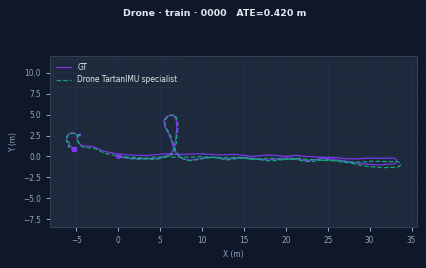
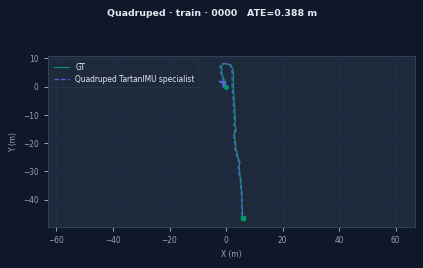
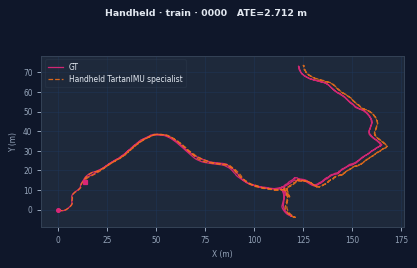
Each platform page provides split statistics, trajectory previews, sensor characteristics, and domain-specific evaluation context.
Protocol at a glance
The model interface stays compact while evaluation measures the accumulated motion that matters in deployment.
0.6 × (AVE / 0.7356384388) + 0.4 × (ATE20 / 3.1160277267) — macro-averaged over the four platforms, each contributing 25 %. Lower is better; an all-zero submission scores exactly 1.000.‖v_pred − v_gt‖.Organizers and partners
The challenge is organized by CMU AirLab and Amazon FAR in conjunction with the IROS 2026 workshop on interoceptive perception, with support from the Shanghai Innovation Institute.




Announcements
Per-sequence scoring is now open. Upload your submission to get ATE20, AVE and RTE for all 89 test sequences — the numbers required by the technical report — using the same scoring logic as the Kaggle leaderboard. Open the scoring tool. Five submissions per team per day; your team name must match Kaggle exactly, and teams with no Kaggle submission are not scored.
How the Top 10 teams are selected. The Kaggle leaderboard is not the only criterion — the committee also weighs the quality of the technical report. The Top 10 teams will be invited to contribute to the forthcoming IMU Foundation Model white paper.
Technical report: deadline, format and how to submit. The report is due 23:59 US Eastern Time on 23 September 2026 — three days after the leaderboard closes, which remains September 20, 2026, 23:55 UTC. Maximum 6 pages excluding references and 7 pages in total; the appendix does not count towards either limit. Download the report template (LaTeX source plus a PDF preview; on Overleaf use New Project → Upload Project and select the zip). The report is not uploaded on this website: fill in the challenge Form as usual and attach the report at the end of the Form. Every report must answer the five compliance questions listed in the setup guide.
Final Kaggle submissions and model weights are due September 20, 2026, at 23:55 UTC. See the rules timeline.
The competition is live on Kaggle: TartanIMU Challenge: Multi-Platform Inertial Odometry.
The official dataset release hub is available from the challenge data page.
Platform pages for Car, Drone, Quadruped, and Handheld are published.
The initial IMU Odometry Challenge website and benchmark structure launched.
Research resources
Run the TartanIMU specialist models in the Hugging Face demo. Cite the paper and benchmark when using these resources.
@InProceedings{Zhao_2025_CVPR,
  author    = {Zhao, Shibo and Zhou, Sifan and Blanchard,
               Raphael and Qiu, Yuheng and Wang, Wenshan and
               Scherer, Sebastian},
  title     = {Tartan IMU: A Light Foundation Model for
               Inertial Positioning in Robotics},
  booktitle = {Proceedings of the IEEE/CVF Conference on
               Computer Vision and Pattern Recognition (CVPR)},
  month     = {June},
  year      = {2025},
  pages     = {22520-22529}
}@misc{imuchallenge2026,
title={IMU Odometry Challenge: Cross-Platform Inertial
Positioning Benchmark},
author={CMU AirLab and Super Odometry Group},
year={2026},
howpublished={\url{https://superodometry.com/imuchallenge/}},
note={Dataset and benchmark challenge page}
}